Baking is a complex food process with many ingredient and process interactions. Most bakery items are made of the same ingredients: flour, water, sugar, eggs, leavening agents and fat.
The transition from raw materials to baked product is most often referred as being a change from foam to a sponge.
Browning reactions, gelatinization of starch, and denaturation of protein are some of the key biochemical processes involved in baking.
The activity of baking includes takes like mixing the batter, preheating the oven, putting the pan in the oven and taking the cake out of the oven at the right time.
Baking begin with its most elementary ingredient: wheat flour. Its special properties allow bakers to produce an astonishing array of products from pastry to cakes and cookies.
When mixing, batters and dough trap pockets of air as paddles and whips push through them. With continued mixing, large air pockets are reduced in size to many more smaller ones, providing the ‘nuclei’ that expand during baking into full-sized air cells.
A gluten structure of wheat allows dough to hold steam or expanding air bubbles, so that yeasted dough can rise and puff pastry can puff.
Salt does not only help regulate yeast fermentation but also strengthen gluten and makes it more elastic.
Solid fats mixed into a dough or batter trap air, water and some leavening gases. When the fats, melt, these gases are released and the water turns to steam, both of which contribute to leavening.
Different fats have different melting points, but most fats used in baking melt between 32 ° and 55° C. Gases released early in baking are more likely to escape because the structure isn’t set enough to trap all of them.
What is happening during baking?
Showing posts with label baking. Show all posts
Showing posts with label baking. Show all posts
Tuesday, July 09, 2013
Friday, September 28, 2012
Bread baking process
The function of baking is to present cereal flours in an attractive, palatable and digestible form.
Most bakery products are made of the same few ingredients – flour, shortening, sugar, eggs, water or milk and leavenings.
The dough is kneaded by hand or machine. After the dough rests for some time (about 2 hours) it is manipulated to push out the gas that has been evolved.
Three process are commence when the ingredients for bread making are mixed.
*The protein in the flour begin to hydrate and to combine with some water , to form gluten.
*Air bubbles are folded into dough. During the subsequent handling of the dough these bubbles divide or coalesce.
*Enzyme in the yeast start to ferment the sugars present in the flour and later sugar released by diastatic action of the amylases on damaged starch in the flour, breaking them down to alcohol and carbon dioxide.
The dough is then moulded into loaf shape and allowed to rest in the baking pan for 45 to 60 minutes at 38° – 48° C for final proof and is then baked for about 30 minutes with steam injected into the oven to produce a glaze on the crust.
Loaf sized are breads is baked in an oven pre-heated to 204° C. After the first 15 minutes of baking, the temperature is reduced if the crusts become to brown. Baking is continued until the bread is fully baked.
There are four major changes to the dough piece which can be seen as it is baked:
*A large reduction in product density – the dough gets thicker, associated with development of an open porous or flaky structure
*A change of shape associated with shrinkage or spread and increase on thickness
*A reduction in moisture level, to between 1-4%
*A change in surface coloration
Bread baking process
Most bakery products are made of the same few ingredients – flour, shortening, sugar, eggs, water or milk and leavenings.
The dough is kneaded by hand or machine. After the dough rests for some time (about 2 hours) it is manipulated to push out the gas that has been evolved.
Three process are commence when the ingredients for bread making are mixed.
*The protein in the flour begin to hydrate and to combine with some water , to form gluten.
*Air bubbles are folded into dough. During the subsequent handling of the dough these bubbles divide or coalesce.
*Enzyme in the yeast start to ferment the sugars present in the flour and later sugar released by diastatic action of the amylases on damaged starch in the flour, breaking them down to alcohol and carbon dioxide.
The dough is then moulded into loaf shape and allowed to rest in the baking pan for 45 to 60 minutes at 38° – 48° C for final proof and is then baked for about 30 minutes with steam injected into the oven to produce a glaze on the crust.
Loaf sized are breads is baked in an oven pre-heated to 204° C. After the first 15 minutes of baking, the temperature is reduced if the crusts become to brown. Baking is continued until the bread is fully baked.
There are four major changes to the dough piece which can be seen as it is baked:
*A large reduction in product density – the dough gets thicker, associated with development of an open porous or flaky structure
*A change of shape associated with shrinkage or spread and increase on thickness
*A reduction in moisture level, to between 1-4%
*A change in surface coloration
Bread baking process


Thursday, September 22, 2011
Process of Baking
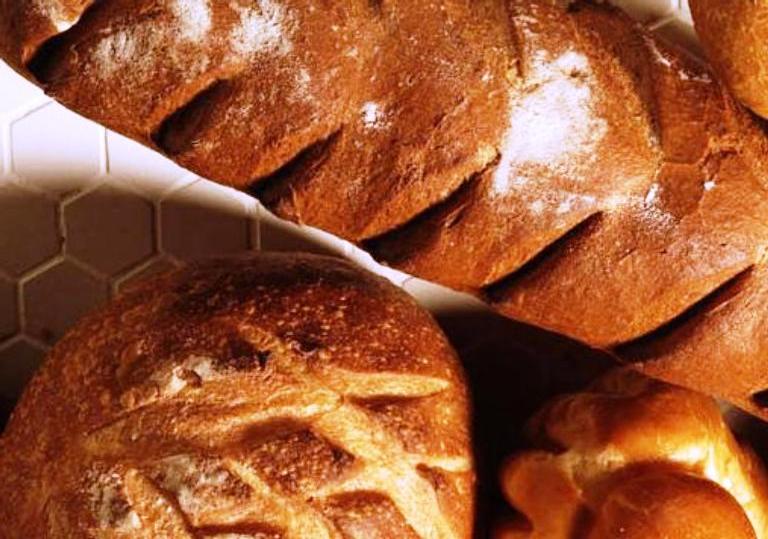
Bread and other baked products have been reported as the main nutritional sources today.
European populations are estimated to obtain approximately half of their required carbohydrates and about one-third of their protein from bread.
Baking is probably the most famous department in the culinary arts. In the culinary arts, baking is the art of cooking food using an oven.
The food is cooked through applying dry heat evenly through the oven and into the food. It is used in producing pastry based goodies such as pies, tarts and cakes.
The baking guidelines for cookies vary incredibly, depending on the type and formulation. Some cookie dough may be refrigerated or frozen for later uses depending on the chemical leavening agents present and the mixing process used.
Cookie dough that contains baking powder has a high tolerance for storage in the refrigerator and freezer because the majority of the gas is created during exposure to heat.
The dry heat in the oven causes the starch to gelatinize and results to the browning or charring of the outside of the food.
Dough are exposed to a defined heat for a certain time during the baking process in the oven. Baking stability of the preparation means that it does not start boiling or melting.
Some people in the culinary arts might think that the charred part or the brown part is not as tasty as it sounds, but this part is actually what gives taste and flavor to the baked good, partly sealing the moisture of the food.
The browning apparent in the baked good is caused by the sugar caramelizing and the chemical reaction that happens between the reduction of sugar and the amino acid (Millard reaction).
Moisture in the baked goody, on the other hand, is not really completely kept in, in time as the goody is being baked it will become drier and drier.
There are stages in baking process take places as follows:
*Formation and expansion of gases
*Trapping of the gas in air cells
*Coagulation of proteins
*Gelatinization of starches
*Evaporation of water
*Melting of shortenings
*Crust formation and browning
In baking industry, large numbers of processes are used, in which the processing time and conditions can be altered. With the introduction of new technologies, for examples, frozen and par-baked breads, new requirements are set for the baker’s skills.
Process of Baking

Subscribe to:
Posts (Atom)
Most Popular Articles
-
Bactofugation is a process used to eliminate bacteria contained in milk using centrifugal force. It is a special form of separation of micro...
-
 Brie, a cheese that is surface ripened by mold, is very similar to Camembert. Differences exist, however, in the internal ripening and in th...
 -
 Camembert is a tiny hamlet that was made famous back in 1791 by Marie Harel, a farmer from Normandy. For a long time, Camembert cheese was o...
 -
 The oat flaking process is a carefully controlled sequence of steps that transforms whole oat grains into the familiar flat flakes used in b...
 -
 Nearly all animal fats, tallow or beef fat and lard, are obtained bv rendering. The two predominant rendering processes are wet and dry rend...

