Showing posts with label food preservation. Show all posts

Sunday, August 13, 2023

Smoking for Food Preservation

Smoke curing, commonly referred to as smoking, is a time-honored method for preserving food. It encompasses the exposure of food to smoke generated by burning materials, typically wood, with the intention of infusing flavor, aiding in cooking, and extending the product's shelf life. Throughout this procedure, interactions occur between the food and the smoke, yielding a distinctive taste. The approach involves subjecting the food to controlled environments, combining steps such as salting, drying, heating, and smoking within specialized chambers.

The smoke, produced by the controlled smoldering of materials like hardwood chips, herbs, fruit peels, or spices, serves a multitude of purposes. It acts as a deterrent to bacterial growth and possesses antioxidants, thus contributing to the prolonged preservation of products. Furthermore, the smoke imparts an exclusive blend of flavor, aroma, texture, and visual appeal to the food. This tradition continues to be prevalent in safeguarding fish, meat, and other consumables.

Diverse fish species demand varying methods of preparation. For example, salmon requires backbone removal and splitting, while bottom-dwelling fish are filleted. Smaller fish like herring are commonly gutted and decapitated prior to undergoing brining.

The genesis of smoke involves the incomplete combustion of wood, which subsequently results in the thermal degradation of complex organic compounds into volatile, smaller substances. Smoke is composed of two phases: a dispersed phase containing droplet-like particles and a gaseous phase. The particles in the dispersed phase exhibit an average diameter spanning from 0.196 to 0.346 µm.

The smoking process instigates interactions between the food and smoke, culminating in the formation of an additional layer on food or meat products. This supplementary layer introduces volatile compounds that not only impede bacterial proliferation but also infuse a distinctive flavor. The range of temperatures for the smoking process generally extends from 65°F to 250°F.

The practice of smoking food aligns with the revival of traditional crafts and an amplified consciousness regarding the contents of the food we consume. This trend promotes high-quality, unhurried victuals composed of local, unadulterated constituents, bereft of chemical additives. Smoking functions as a valuable avenue for farmers, smallholders, hunters, and fishermen to effectively utilize surplus meat or fish during specific time frames.
Smoking for Food Preservation

Thursday, January 13, 2022

Process of dry salting

Dry salting is a process of fermentation method that involves sprinkling salt onto a dry vegetable or fish in order to draw out the water. Salting is one of the oldest methods of preservation. Salting is a process where the common salt (NaCl), sodium chloride, is used as a preservative that penetrates the tissue; hence prevent or drastically reduce bacterial action.

Penetration ends when the salt concentration of the tissue equals that of the surrounding medium. This phenomenon is known as osmosis.

Some of the factors involved in salting of fish which play important role are purity of salt, quantify of salt used, method of salting, and weather conditions, flavor of the product.

In dry salting, the size of salt crystals is important. Fine crystals tend to dissolve too quickly and are dragged down and drained, whereas large crystals dissolve very slowly and there is a risk of deterioration. Fine crystals and larger crystals should be combined. The fine crystals will dissolve quickly and salt will penetrate the flesh immediately.

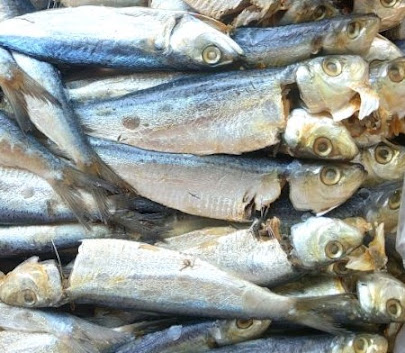
Salting is one of the techniques for preserving fish and has been practiced for a long period of time; it is an alternative to lowering the water activity of fish flesh. Dry salting is the most widely used method of fish curing. The main purpose of salting is to separate water from the fish and replace it with salt. Thus, the water concertation in fish decreases.

The fish is gutted, beheaded or ventrally split open and the viscera removed followed by washing. Scoring is also practiced if the flesh portion is thick for facilitating better salt penetration. Salt is then applied in the ratio 1:3 to 1: 10 (salt to fish) depending upon the size of the fish.

To ensure that fish dries well, dry salting is recommended for lean fish, not fatty fish.
Process of dry salting 

Monday, August 07, 2017

Food preservation by curing process

Preserving food by various methods has been practiced throughout human history. Curing was originally developed to preserve certain foods by the addition of sodium chloride. In the food industry, the application of curing is related only to certain meat, fish and cheese products.

Meat curing, as commonly performed in products such as ham, or sausage involves the addition of mixtures containing salt, nitrite and other preservatives. Today sodium chloride and sodium and potassium nitrite are considered as curing salts.
Over several millennia additional processes concomitant with curing have evolved, notably fermentation, smoking, drying and heating. Most of these methods work through removing moisture from the meat and replacing it with salt and preserving agents that inhibit the growth of bacteria and decay.

Food treated by curing must be re-hydrated and carefully rinsed before use. It is also still considered raw, so meats will still require cooking.

An important benefit to curing meat for use in the home is to maintain a readily available source of meat when the electricity goes out and there is no refrigeration.

For some people, the greatest benefit might be to known that their family will not be exposed to some of the various chemicals that are found in commercially prepare meats.
Food preservation by curing process

Most Popular Articles

BannerFans.com