The term drying refers generally to the removal of moisture from a
substance. It is one of the oldest, most commonly used and most energy
consuming unit operation in the process industries.
The hot air drying technique is the most frequently used technique to
produce dehydrated vegetables and fruits, in which heat is transferred
from the hot air to the product by convection, and evaporated water
is transported to the air also by convection.
Air that has a low moisture concentration is blown through the material
bed so that it absorbs water molecules from the product away. In some
dryers the air flow is also what is used to heat the material being
dried.
Hot air driers are classified as parallel flow, counter flow, direct
flow, or cross flow, pending on the direction in the product moves in
direction to the direction of flow of the heated air.
Hot-air drying is efficient at removing free water as long as
it’s present as continuous liquid phase (high water content)
preventing thermal deterioration of the products; this removal is
governed by Fick’s Law. The water elimination generates
shrinkage decreasing the internal water diffusivity and
increasing the thermal conductivity of the product and thus the
internal heat transfer.
Hot air drying
Showing posts with label moisture. Show all posts
Showing posts with label moisture. Show all posts
Sunday, June 30, 2019
Friday, March 18, 2016
Tea leaves drying process
Drying achieved by blowing hot air through tea leaves, arrests oxidation by inactivating enzymes, resulting in color enhancement and the final balance of tea aroma and reduces the moisture content of the leaves to less than5%.
In Keemun black tea processing, the leaves are subjected to drying after fermentation at 110 °C– 120 °C for 10 – 15 min. The moisture will drop below 20%.
After spreading the first dried leaves, another drying is carried out at 70 °C – 90°C for 45 –60 min to moisture below 4%.
Drying is usually done by a drying machine such as the multi-band drier or fluid bed drier.
The temperature is sufficient to inactivate the polyphenol oxidases. The sap released during rolling and fermentation solidifies during drying on the fine little hair on the surface of the leaf.
During drying, aroma substances are formed and the coppery-red color is changed to black (hence ‘black tea’).
Following the drying the leaves are sorted and graded to yield a commercial product.
Tea leaves drying process
In Keemun black tea processing, the leaves are subjected to drying after fermentation at 110 °C– 120 °C for 10 – 15 min. The moisture will drop below 20%.
After spreading the first dried leaves, another drying is carried out at 70 °C – 90°C for 45 –60 min to moisture below 4%.
Drying is usually done by a drying machine such as the multi-band drier or fluid bed drier.
The temperature is sufficient to inactivate the polyphenol oxidases. The sap released during rolling and fermentation solidifies during drying on the fine little hair on the surface of the leaf.
During drying, aroma substances are formed and the coppery-red color is changed to black (hence ‘black tea’).
Following the drying the leaves are sorted and graded to yield a commercial product.
Tea leaves drying process


Tuesday, January 02, 2007
The Effect of drying on microorganisms
The Effect of drying on microorganisms
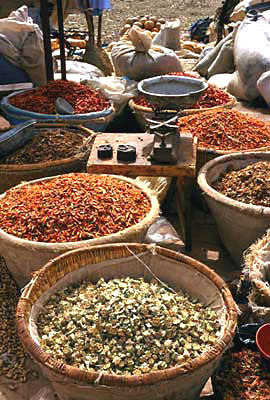
The main purpose of drying foods is to lower their moisture content to a particular level that will exclude the growth of microorganisms (bacteria, mould and yeasts).
For any given moisture content, one food may support the growth of microorganisms will growth in a dried food depends on the water activity.

The lower the water activity of a food, the less probable that microorganisms will grow. Generally, mold at lower water activities than yeasts and yeasts will grow at lower water activities than bacteria. For this reason, mold are opt to grow in dried foods than are yeasts or bacteria.
In dried foods, the moisture content is lowered to the point which microorganisms will not grow and it is kept that way through packaging, which includes moisture.

Water activity also can be lowered by soluble components, such as sugar or salt.
Thus, certain syrup and salted, partially dried foods (e.g foods) are relatively stable as far as at the growth of microorganisms is concerned , although there may be conditions in which they become subject to the growth of yeasts or molds.
The Effect of drying on microorganisms
Subscribe to:
Posts (Atom)
Most Popular Articles
-
 A melanger is a cornerstone in the artisanal chocolate-making process, widely used in the bean-to-bar industry to refine and conch chocolate...
 -
 Cheese curls are light, crunchy snack foods made primarily from cornmeal. Recognizable by their small, curved shapes and bright cheese coati...
 -
 Direct exchangers are based on mixing of heating steam with the liquid food product resulting in very fast heat transfer rate. Steam injecti...
 -
 Essential oils are concentrated, aromatic liquids extracted from various parts of plants, including flowers, leaves, stems, bark, roots, see...
 -
 Preserving food by various methods has been practiced throughout human history. Curing was originally developed to preserve certain foods by...

